
Things to Do After a Car Accident:
Essential Accident Steps and Safety Tips
(561) 626-6007
Prioritize Your Safety and Get to Safety After a Car Accident
Immediately after a car accident, your primary concern should be your personal safety and the safety of any passengers. Whether your car has sustained a minor bump or serious damage, it’s essential to check yourself and others for injuries before doing anything else. If it’s safe, move your vehicle out of the traffic flow to help prevent further accidents and protect you from additional harm. Many accident scenes become even more hazardous when a driver or vehicle remains in an active lane, especially on busy Lake Worth roadways.
Turning on your hazard lights alerts approaching vehicles to your accident and presence on the road, reducing the risk of another collision. If the vehicle can’t be moved, leave it where it is, but make sure that you and your passengers exit the auto as safely as possible without stepping into traffic. Always be cautious while moving around the accident site, and keep other drivers in mind—the chaos after an accident increases the risk of a second auto incident. If you have safety triangles or cones in your car, placing them behind your vehicle can give other drivers added warning as they approach the area.
As a personal injury lawyer with Stillman Injury Law, I urge you to stay calm and breathe deeply. Prioritizing your safety at the accident scene can make a genuine difference in the outcome of your claim and your well-being. If you can, exit your vehicle and stand at a safe distance while waiting for help. Remember, even if your car looks drivable, hidden damage can make it unsafe to operate until a professional inspects it. Never try to move a severely damaged auto or vehicle unless law enforcement explicitly instructs you to do so. When everyone is safe, you’ll be better prepared to follow the next steps—like notifying authorities,
gathering accident documentation, or dealing with other drivers and witnesses.
If you need personal, respectful legal support after a Lake Worth accident, reach out to Stillman Injury Law—we’re here to protect your rights and answer your questions.
Follow Our 6 Step Guide Below
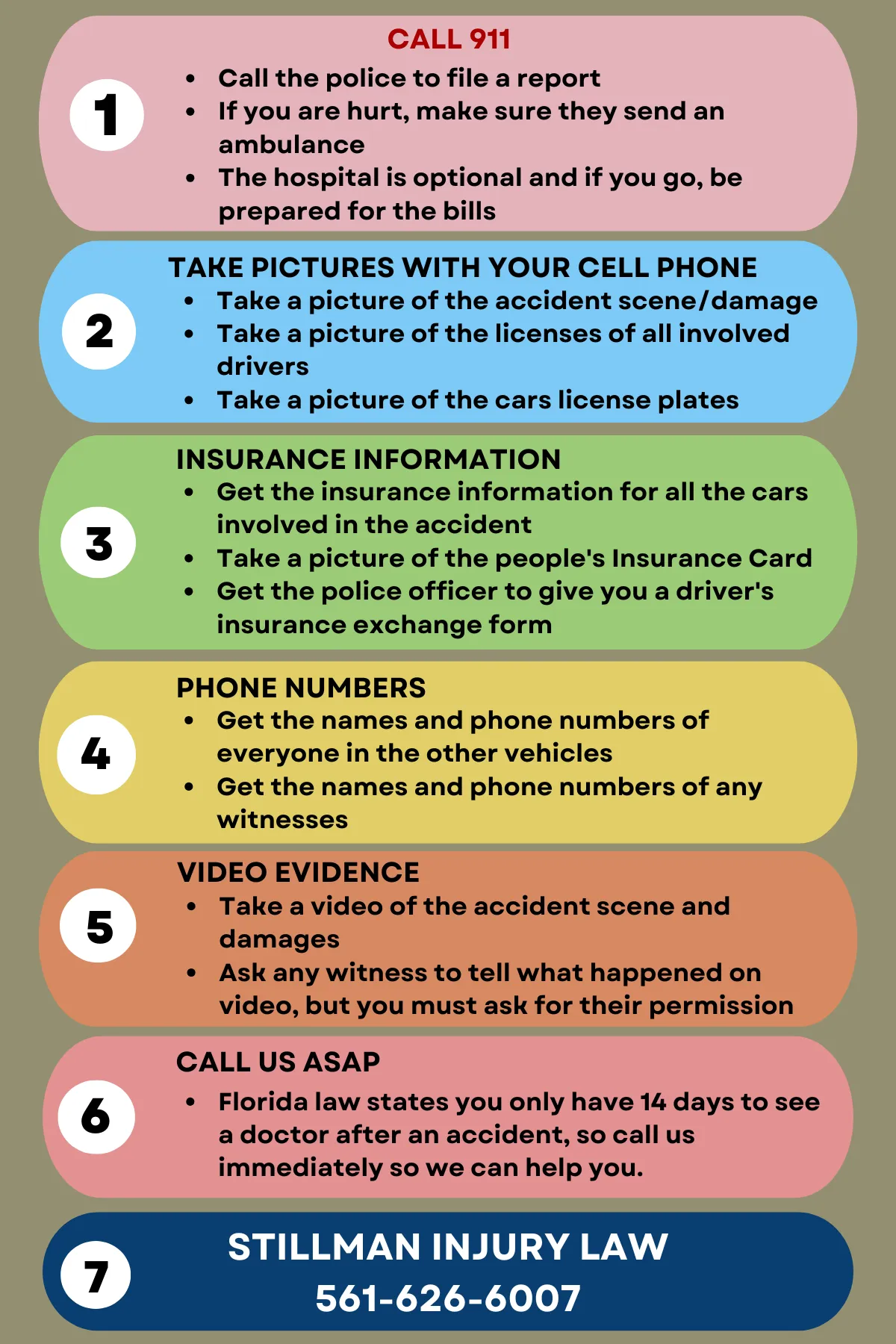
Notify Authorities:
When and How to Call the Police
Once you've ensured everyone’s safety after a car accident, your next step should be to call the police and notify authorities, no matter how minor the accident may appear. In Lake Worth, Florida, drivers are often legally required to report an auto incident, especially if there’s property damage, injuries, or concerns about liability. Even if the car crash seems minor, having an official report provides essential protection for your claim and can prevent complicated disputes with the other driver or multiple drivers down the line.
When contacting the police, remain calm and clearly state the location of the accident, details about the vehicles involved, and whether medical assistance is needed. The responding authorities will assess the scene, help manage traffic, and ensure everyone
receives proper protection, which can be especially important if any driver becomes confrontational or uncooperative. Remember, authorities will document the facts, interview witnesses, and help establish an official record—this report often becomes your key piece of evidence when negotiating with insurance or pursuing a legal claim.
Collecting a copy of the accident report from the authorities strengthens your position for any future claims, repairs, or legal actions. Don’t leave the accident scene before speaking to the
responding officer, and always verify the report for accuracy before signing anything. Your careful actions—phoning the authorities, documenting your auto damage, and maintaining
safe contact with every other driver—help reduce stress and make the claims process smoother.
At Stillman Injury Law, we encourage drivers to seek prompt legal advice following any accident or car crash. If you have questions about a report, dealing with insurance claims, or your options for repair and compensation, contact us anytime. You deserve clear answers and peace of mind as you move forward.
Understanding the Need for Immediate Medical Attention
After you’ve made sure everyone is out of harm’s way and notified the authorities following a car accident, it’s absolutely vital to see a doctor as soon as possible—even if you think your injuries are minor. Many injuries, like whiplash or soft tissue damage, may not be obvious at the scene. Delayed symptoms could worsen over time, so seeking prompt medical attention helps catch problems early and supports both your recovery and your personal injury claim. As a personal injury lawyer serving Lake Worth, I often meet clients who skip this step, only to face complications later with both their health and their insurance claims.
Medical documentation created when you seek medical care immediately is one of the most critical pieces of evidence in a car accident claim. Insurance companies and their adjusters frequently look for ways to minimize or deny claims related to car accidents. If there’s a gap between the crash and the first doctor’s visit, the insurance company might suggest your injuries weren’t serious, or that they weren’t even caused by the accident. Documents from your medical care provider establish a clear link between the accident and your injuries— giving your attorney or lawyer the leverage needed to advocate for you with insurance adjusters or in court, should the claim escalate that far.
If you’ve been involved in any auto accident, don’t downplay your need for care; seek medical attention without delay. Make sure to keep copies of all medical records, bills, prescriptions, and follow-up instructions. These documents play a major role if you need to
file claims against auto insurance or make personal injury claims for compensation. At Stillman Injury Law, we know how overwhelming it is to manage medical and legal processes together. Our team guides you through every step—from ensuring your medical recovery comes first, to helping you build the strongest case possible. If you have concerns about your injuries or the insurance and claims process, reach out to us and get answers from an attorney who puts your health and future first.
Gathering Essential Information and Documentation at the Accident Scene
After confirming everyone’s safety, calling the authorities, and seeking medical attention, your next priority at a car accident scene in Lake Worth is to gather all the vital information and documentation you’ll need for your insurance claim, repair, and possible legal actions. Fast, accurate gathering of details from other drivers, witnesses, and the accident site itself can make or break your case with the insurance company—or in court. As a personal injury lawyer with Stillman Injury Law, I’ve seen first-hand how missing or inaccurate information can delay claims, complicate liability, and hinder your financial recovery. That’s why gathering details now matters.
What Details to Collect From Other Drivers, Witnesses, and for Your Insurance Claim
Collecting the right information and documentation at the accident scene is critical for protecting your rights and ensuring a smooth insurance claim process. First, exchange essential information with each driver involved. This includes names, addresses, driver’s
license numbers, contact information, vehicle make, model, color, license plate numbers, and—most importantly—their insurance company name and car insurance policy number. Make sure you physically see their driver’s license and insurance card, not just hear it, to avoid honest mistakes or intentional misreporting. Take clear photos of each document and the vehicles, focusing on license plates, points of impact, damage, and surrounding road conditions for complete documentation.
If there are witnesses at the scene, quickly and politely ask for their names and contact information. Independent eyewitnesses often provide crucial details about the accident, especially if liability is disputed between drivers and insurance companies. Even a single witness report can greatly support your version of events, helping shift the outcome of your claim or any ensuing repairs and damages. If any injuries are visible, photograph these if possible, as visible evidence strongly validates your report and supports your claim before the insurance company or, if necessary, in court.
Don’t forget to record every detail you can remember: accident time, weather and lighting, road conditions, and how the collision unfolded. Use your phone’s notes or a blank piece of paper to jot down your own recollections as soon as you’re able. Gather the names and badge numbers of responding law enforcement officers for your records—they’ll write the official police report, which your attorney, insurance company, or repair shop may later request. Secure a copy of this official report for your file; it’s among the most valuable documentation in car accident claims, repairs, or liability disputes. Save every contact— driver, witness, officer—and organize all documentation so that, whether handling repairs or contacting Stillman Injury Law for legal advice, you’re fully prepared and protected. Don’t hesitate to reach out to an attorney after any accident; prompt, informed action is the best way to safeguard your claim, speed up repair, and secure fair compensation for your injuries and losses.
If a Picture is Worth a Thousand Words Then Video is Worth Millions
You’ve probably heard the saying: “A picture is worth a thousand words.” In an auto accident case, that’s absolutely true.
A single clear photo can instantly show:
· Who was involved
· Where the vehicles ended up
· Visible damage to the cars
· Weather, lighting, and road conditions
Photos are powerful. They can contradict inaccurate statements, support your version of events, and give an insurance adjuster or jury something concrete to look at. But when it comes to serious injury claims and proving what really happened, video is on another level. If a picture is worth a thousand words, a well-shot video of the scene can be worth millions — sometimes literally millions of dollars in case value — because it captures not just a moment, but the entire story.
What Video Shows That Photos Can’t
A good accident-scene video, taken right after the crash, can capture things no photo ever will:
1. The Sequence of Events
Video shows time and motion:
· How vehicles are positioned as people move around
· Whether someone is walking normally right after the crash and later claims they couldn’t move
· How quickly airbags deflated, fluids leaked, or smoke appeared
This continuous record helps show what happened and in what order.
2. Voices, Behavior, and Admissions
With video, you don’t just see the scene — you hear it:
· What drivers and witnesses say on the spot:
o “I didn’t see you.”
o “I was looking at my phone.”
o “I ran the light, I’m so sorry.”
· Tone of voice (calm, intoxicated, panicked, apologetic)
· Real-time reactions that are extremely hard to fake later
These live admissions can be critical evidence.
3. Full 360° Context
Video lets you walk the viewer through the scene:
· Traffic signals and stop signs in the background
· Blind spots and obstructions (parked cars, vegetation, sun glare)
· Surrounding homes or businesses that might have useful camera footage
Photos are static. Video feels like you’re there in person.
4. Movement and Dynamics
Accident reconstruction often depends on how things moved:
· The way the cars came to rest and how far they traveled after impact
· Skid marks and debris in relation to lanes and intersections
· The relative positions of vehicles, signs, and landmarks as you walk around
A well-narrated video can serve as a live diagram of the crash.
5. Continuous Storytelling
Instead of isolated snapshots, video gives you a continuous narrative:
“Here is my car… here is the other car… here is where the impact happened… here are the skid marks… here’s the broken glass…”
That full story is much harder for the other side to twist or take out of context.
What Police Video Usually Misses — and Your Own Video Can Capture
Your own video, taken deliberately with your case in mind, can document details that are often missing or incomplete in official footage:
Impacted Vehicles & Damage
· Close-up passes around each car
· Crumpled panels, broken lights, bent frames, wheel angles
· Visible intrusion into the cabin, broken glass, crushed bumpers
These visual details help show force of impact, not just “it was a tap.”
Vehicle Positions Right After the Crash
· Where each vehicle came to rest before tow trucks move them
· Distances from stop signs, traffic signals, and intersections
· Orientation within or across lanes
This is vital for reconstructing how the crash happened.
Skid Marks, Yaw Marks, and Debris
· Length and direction of skid marks (key for estimating speed and braking)
· Debris fields and fluid trails that trace the collision path
· Gouge marks in the pavement showing the true point of impact
These details fade quickly — video preserves them.
Airbag Deployment & Interior Evidence
· Which airbags deployed (driver, passenger, side curtains, etc.)
· Condition of seatbelts and interior components
· Child seats, loose objects, shattered interior glass
This all helps link mechanism of injury to your medical claims.
Environmental Conditions
· Weather at the time: rain, fog, glare, dry or wet pavement
· Road surface quality: potholes, gravel, oil, worn markings
· Visibility: blocked sightlines, shrubbery, parked trucks or trailers
Recorded immediately, this becomes extremely persuasive later.
Contact Stillman Injury Law Today
Navigating the aftermath of a car accident can be overwhelming, but you don't have to face it alone. If you've been involved in a collision in Lake Worth or anywhere in Palm Beach County, and have questions about your rights, medical care, or how to deal with insurance companies, our team at Stillman Injury Law is here to help. We offer compassionate, knowledgeable legal support to guide you through every step of the process. Don't hesitate to reach out for a FREE Accident Consultation to discuss your case and understand your options. Call us today at 561-626-6007 or visit our office at 7681 Lake Worth Rd, Lake Worth, FL 33462. We're here Monday through Friday, 9 AM to 5 PM, ready to provide the peace of mind and dedicated advocacy you deserve.

Accidents Happen
That is why we are here.
Phil is here to personally help you with your case.
STILLMAN INJURY LAW
7681 LAKE WORTH RD
LAKE WORTH, FL 33462
Hours Of Operation
Mon - Fri: 9am - 5pm
Sat & Sun: Closed